In about 600 BC, the Ancient Greeks discovered that rubbing fur on amber (fossilized tree resin) caused an attraction between the two – and so what the Greeks discovered was actually static electricity. Additionally, researchers and archeologists in the 1930’s discovered pots with sheets of copper inside that they believe may have been ancient batteries meant to produce light at ancient Roman sites. Similar devices were found in archeological digs near Baghdad meaning ancient Persians may have also used an early form of batteries.
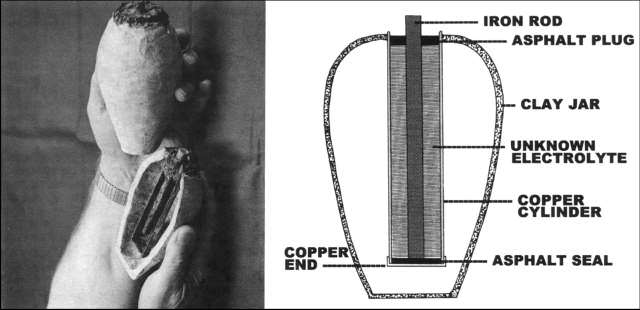
A replica and diagram of one of the ancient electric cells (batteries) found near Bagdad.
In the year 1600, English physician William Gilbert used the Latin word “electricus” to describe the force that certain substances exert when rubbed against each other. A few years later another English scientist, Thomas Browne, wrote several books and he used the word “electricity” to describe his investigations based on Gilbert’s work.
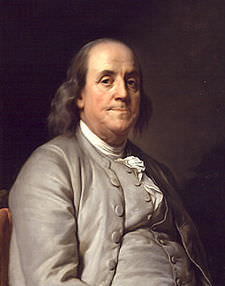
Benjamin Franklin. Image Source: Wikipedia
Italian physicist Alessandro Volta discovered that particular chemical reactions could produce electricity, and in 1800 he constructed the voltaic pile (an early electric battery) that produced a steady electric current, and so he was the first person to create a steady flow of electrical charge. Volta also created the first transmission of electricity by linking positively-charged and negatively-charged connectors and driving an electrical charge, or voltage, through them.
In 1831 electricity became viable for use in technology when Michael Faraday created the electric dynamo (a crude power generator), which solved the problem of generating electric current in an ongoing and practical way. Faraday’s rather crude invention used a magnet that was moved inside a coil of copper wire, creating a tiny electric current that flowed through the wire. This opened the door to American Thomas Edison and British scientist Joseph Swan who each invented the incandescent filament light bulb in their respective countries in about 1878. Previously, light bulbs had been invented by others, but the incandescent bulb was the first practical bulb that would light for hours on end.
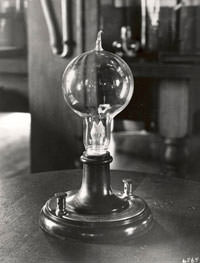
Replica of Thomas Edison’s first lightbulb. Credit: National Park Service.
Later in the 1800’s and early 1900’s Serbian American engineer, inventor, and all around electrical wizard Nikola Tesla became an important contributor to the birth of commercial electricity. He worked with Edison and later had many revolutionary developments in electromagnetism, and had competing patents with Marconi for the invention of radio. He is well known for his work with alternating current (AC), AC motors, and the polyphase distribution system.
Later, American inventor and industrialist George Westinghouse purchased and developed Tesla’s patented motor for generating alternating current, and the work of Westinghouse, Tesla and others gradually convinced American society that the future of electricity lay with AC rather than DC.
Others who worked to bring the use of electricity to where it is today include Scottish inventor James Watt, Andre Ampere, a French mathematician, and German mathematician and physicist George Ohm.
And so, it was not just one person who discovered electricity. While the concept of electricity was known for thousands of years, when it came time to develop it commercially and scientifically, there were several great minds working on the problem at the same time.
We have written many articles about electricity for Universe Today. Here’s a separate article about static electricity, and here’s an interesting story about how astronomy was part of how electricity was brought to the World’s Fair in Chicago in 1933.
For more detailed information about the discovery of electricity, see our sources, below.
We’ve also recorded an entire episode of Astronomy Cast all about Electromagnetism. Listen here, Episode 103: Electromagnetism.
From the writings of Thales of Miletus it appears that Westerners knew as long ago as 600 B.C. that amber becomes charged by rubbing. There was little real progress until the English scientist William Gilbert in 1600 described the electrification of many substances and coined the term electricity from the Greek word for amber. As a result, Gilbert is called the father of modern electricity. In 1660 Otto von Guericke invented a crude machine for producing static electricity. It was a ball of sulfur, rotated by a crank with one hand and rubbed with the other. Successors, such as Francis Hauksbee, made improvements that provided experimenters with a ready source of static electricity. Today's highly developed descendant of these early machines is the Van de Graaf generator, which is sometimes used as a particle accelerator. Robert Boyle realized that attraction and repulsion were mutual and that electric force was transmitted through a vacuum. Stephen Gray distinguished between conductors and nonconductors. C. F. Du Fay recognized two kinds of electricity, which Benjamin Franklin and Ebenezer Kinnersley of Philadelphia later named positive and negative.
Progress quickened after the Leyden jar was invented in 1745 by Pieter van Musschenbroek. The Leyden jar stored static electricity, which could be discharged all at once. In 1747 William Watson discharged a Leyden jar through a circuit, and comprehension of the current and circuit started a new field of experimentation. Henry Cavendish, by measuring the conductivity of materials (he compared the simultaneous shocks he received by discharging Leyden jars through the materials), and Charles A. Coulomb, by expressing mathematically the attraction of electrified bodies, began the quantitative study of electricity.
A new interest in current began with the invention of the battery. Luigi Galvani had noticed (1786) that a discharge of static electricity made a frog's leg jerk. Consequent experimentation produced what was a simple electron cell using the fluids of the leg as an electrolyte and the muscle as a circuit and indicator. Galvani thought the leg supplied electricity, but Alessandro Volta thought otherwise, and he built the voltaic pile, an early type of battery, as proof. Continuous current from batteries smoothed the way for the discovery of G. S. Ohm's law, relating current, voltage (electromotive force), and resistance, and of J. P. Joule's law of electrical heating. Ohm's law and the rules discovered later by G. R. Kirchhoff regarding the sum of the currents and the sum of the voltages in a circuit are the basic means of making circuit calculations.
In 1819 Hans Christian Oersted discovered that a magnetic field surrounds a current-carrying wire. Within two years André Marie Ampère had put several electromagnetic laws into mathematical form, D. F. Arago had invented the electromagnet, and Michael Faraday had devised a crude form of electric motor. Practical application of a motor had to wait 10 years, however, until Faraday (and earlier, independently, Joseph Henry) invented the electric generator with which to power the motor. A year after Faraday's laboratory approximation of the generator, Hippolyte Pixii constructed a hand-driven model. From then on engineers took over from the scientists, and a slow development followed; the first power stations were built 50 years later.
In 1873 James Clerk Maxwell had started a different path of development with equations that described the electromagnetic field, and he predicted the existence of electromagnetic waves traveling with the speed of light. Heinrich R. Hertz confirmed this prediction experimentally, and Marconi first made use of these waves in developing radio (1895). John Ambrose Fleming invented (1904) the diode rectifier vacuum tube as a detector for the Marconi radio. Three years later Lee De Forest made the diode into an amplifier by adding a third electrode, and electronics had begun. Theoretical understanding became more complete in 1897 with the discovery of the electron by J. J. Thomson. In 1910–11 Ernest R. Rutherford and his assistants learned the distribution of charge within the atom. Robert Millikan measured the charge on a single electron by 1913.

Aucun commentaire:
Enregistrer un commentaire